LOENDERLow-end reference plugin for techno producers
See what you can't hear. A low-end envelope reference.
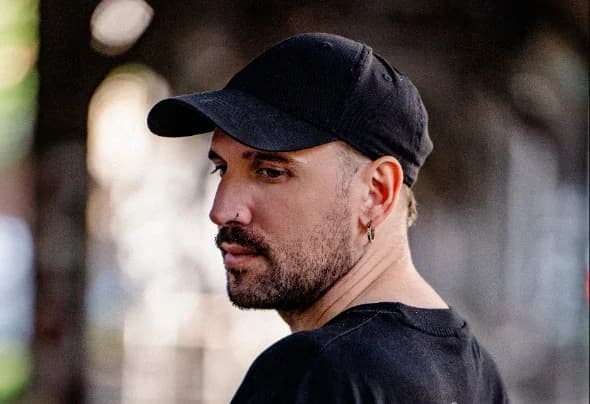
Designed by Mattia Saviolo
See it in action.
What’s inside.
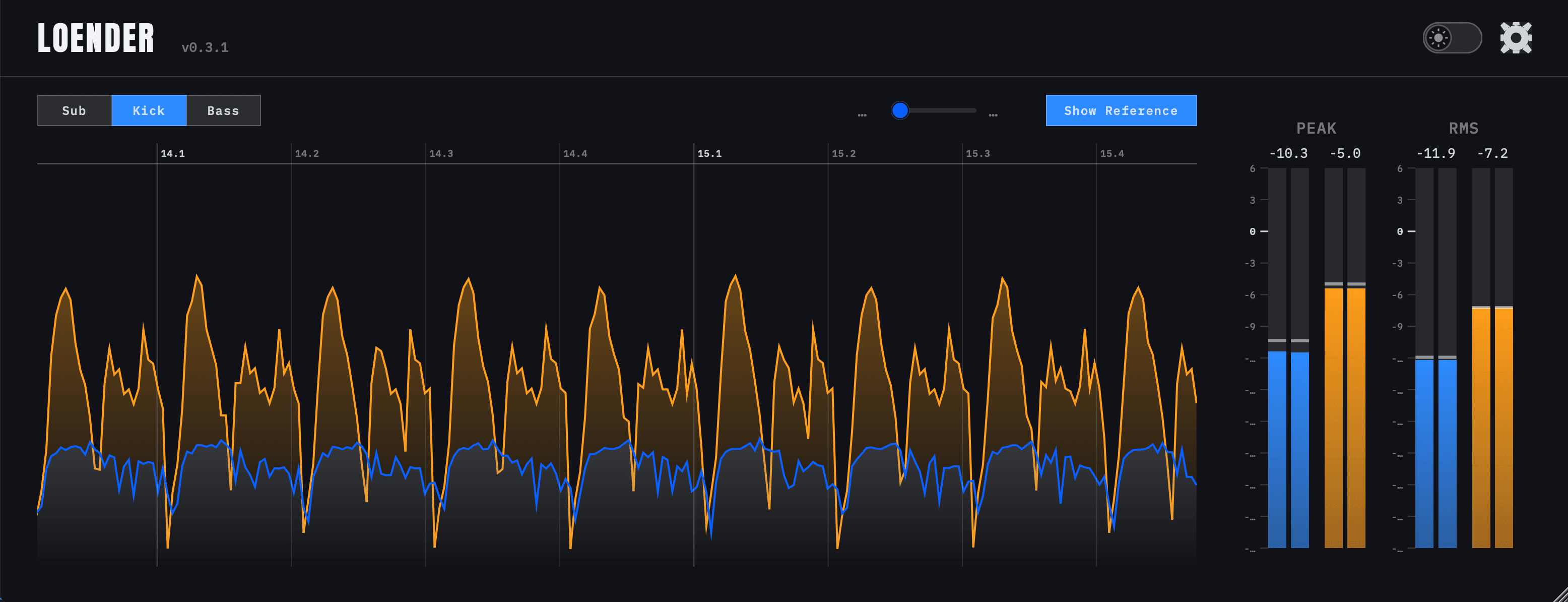
A scrolling view of the signal's amplitude envelope, newest data entering at the right edge — smooth, low-jitter scrolling independent of your host's repaint rate, with an adjustable horizontal zoom.
Three fixed low-pass presets — Sub, Kick, Bass — selected with one click, ~48 dB/octave rolloff, applied before envelope tracking so the display always reflects the filtered signal. Cutoffs are editable per preset.
Route a second track from the same session into LOENDER's sidechain input to compare its low end against your main signal — both visually, as a second lane in the display, and via its own peak/RMS meters.
Peak and RMS bar meters for the main track and, when connected, the reference track.
Envelope Display
01A scrolling view of the signal's amplitude envelope, newest data entering at the right edge — smooth, low-jitter scrolling independent of your host's repaint rate, with an adjustable horizontal zoom.
Low-End Focus
02Three fixed low-pass presets — Sub, Kick, Bass — selected with one click, ~48 dB/octave rolloff, applied before envelope tracking so the display always reflects the filtered signal. Cutoffs are editable per preset.
Reference Track
03Route a second track from the same session into LOENDER's sidechain input to compare its low end against your main signal — both visually, as a second lane in the display, and via its own peak/RMS meters.
Metering
04Peak and RMS bar meters for the main track and, when connected, the reference track.
Why we built a low-end reference.
“In dance music the low end is the most important part of the track, and it’s the part you can hear least reliably. Monitors roll it off, headphones exaggerate it, the room adds its own peaks and dips, and a kick and bass that sound locked together in the studio can still fight each other on a club system.
LOENDER is built around a simple idea: see what you can’t hear. It brings the tools I’ve relied on over a long career of producing, mixing and research into one plugin. It filters your track down to the sub, kick or bass range, draws its envelope in time with your session next to a reference track, and meters both side by side.”
System requirements.
- —VST3, AU — no AAX (not compatible with Pro Tools)
- —macOS 11 (Big Sur) or later — Universal binary, native on Apple Silicon and Intel
- —Windows 10 or later, 64-bit
- —Runs in Ableton Live, Logic Pro, Bitwig Studio, Cubase, Studio One, Reaper and FL Studio
License.
- —Free to download and use
- —No account, no license key, no subscription, no iLok
- —Full terms in the Terms of Service
FAQ.
Is it really free?+
Yes. Enter your email to get the download links, run the installer, and LOENDER is fully unlocked — no license key, no account, no trial period.
Who makes LOENDER?+
Sentinel DSP builds it. Like Sentinella, it comes out of the studio practice of Mattia Saviolo, who co-designed it.
Which formats does it support?+
VST3 on Windows and macOS, AU on macOS.
Which DAWs will it work in?+
Any DAW that hosts VST3 or AU plugins — Ableton Live, Logic Pro, Bitwig Studio, Cubase, Studio One, Reaper, FL Studio and the rest. Pro Tools won't be supported — there's no AAX version.
Will it run natively on Apple Silicon?+
Yes. The macOS build is a Universal binary, so it runs natively on Apple Silicon (M1 and later) and on Intel Macs — no Rosetta needed.